

The book of Moses is Joseph Smith’s inspired and expanded translation of Genesis 1:1–Genesis 6:13.
In it, we learn gorgeous truths revealed to Moses that were eventually lost from the Bible. Some of these teachings have become so familiar to us that we may forget they’re unique to Latter-day Saint theology.
Here are six things we know because of this sacred text.
1. The ‘Why’ of Creation
The very first chapter in the book of Moses is an account of a vision Moses has while on “an exceedingly high mountain.” This vision occurs before Moses speaks with God through the burning bush and before he leads the Israelites out of Egypt. Consider it Moses’s induction into his prophetic role.
In the vision, God talks with Moses face to face and tells him several important truths. As Moses earnestly asks questions, he receives, perhaps most notably, an explanation for all creation.
God tells him, “For behold, this is my work and my glory—to bring to pass the immortality and eternal life of man.”
What a powerful statement! We, God’s children, are His purpose.
2. Satan Rebelled in the Premortal Existence
The details of Lucifer’s fall are sparse throughout the Old Testament, with only one verse in Isaiah implying that he was the ‘son of the morning’ who was banished from heaven. However, the book of Moses gives us more context into Satan’s origin story.
Heavenly Father tells Moses that Satan rebelled in the premortal existence when he volunteered to redeem mankind by destroying man’s agency. Satan also wanted God’s power and glory for himself. In response, Heavenly Father cast Satan down, and he became “the devil, the father of all lies.”
God made it clear that those who didn’t listen to Him would fall victim to Satan’s deception.
3. Satan Didn’t Fully Understand the Fall
Satan plays a critical role in the Garden of Eden: by tempting Eve, he essentially helps usher in the advent of agency and the beginning of the human family. But did he realize he was doing this?
Moses 4:6 clarifies that “he sought also to beguile Eve, for he knew not the mind of God, wherefore he sought to destroy the world” (emphasis added). This verse teaches us that our omniscient Father was able to use Satan’s rebellion for our gain and that Satan was unaware that the Fall was a necessary step toward exaltation.
As President Dallin H. Oaks puts it,
“The evil one, who opposed and sought to destroy the Father’s plan actually facilitated it, because it is opposition that enables choice and it is the opportunity of making the right choices that leads to the growth that is the purpose of the Father’s plan.”
4. Adam Taught His Posterity about Jesus Christ and Was Baptized
The Savior isn’t directly spoken of throughout much of the Old Testament. He’s typically only alluded to through foreshadowing, types, or brief prophecies.
But the book of Moses reveals that Adam and Eve knew about Jesus. In Moses 5:9, after the Fall, the Holy Ghost bears record to Adam of the Father and the Son, whom Adam is told will redeem mankind. Adam prophesies that because of the Redeemer, he shall have joy and reunite with God “again in the flesh,” and Eve testifies of the “joy of our redemption.”
After this, the Lord commands Adam to teach His posterity about repentance and the gospel of Jesus Christ. Later, he is caught away by the Spirit, is baptized by immersion, and receives the Holy Ghost.
These verses from the book of Moses are profound in that they establish that Jesus Christ has always been our Savior. From Eden till now, He has been the constant source of good news.
5. Adam and Eve Were Thankful for the Fall
After Adam receives a testimony of the Savior, he and Eve express their gratitude for the Fall. They understand that they needed to transgress to learn right from wrong and to eventually receive exaltation.
George Q. Morris beautifully explained the eternal value of our earthly experiences when he said:
“All … that seem to be sad inflictions of punishment, sorrow, and trouble are in the end not that. They are blessings. We have attained a knowledge of good and evil, the power to prize the sweet, to become agents unto ourselves, the power to obtain redemption and eternal life.”
6. God Weeps
Enoch was one of the descendants of Adam, and his life is summed up in a few short verses in Genesis. But the book of Moses gives us a much wider glimpse into Enoch’s story.
As a humble yet powerful prophet of God, Enoch builds a city of incredible righteousness called Zion. Over time, Zion is lifted to heaven, where Enoch watches wickedness overtake the earth. Before God sends the fatal flood, He does something that surprises Enoch: He weeps.
Confused by this display of grief, Enoch asks God, “How is it that thou canst weep, seeing thou art holy, and from eternity to all eternity?”
Heavenly Father lovingly explains, “Behold these thy brethren; they are the workmanship of mine own hands. … Wherefore should not the heavens weep, seeing these shall suffer?”
This exchange reveals to us that God really is our Father in Heaven. Though He lets us experience the consequences of our agency, He doesn’t delight in our pain or unhappiness. Far from it, it saddens Him.
And More
The book of Moses is filled with so much more to pore over—fascinating pieces of knowledge to ponder and deeply comforting truths to treasure. Through this text, we can peer into the wilderness of the Old Testament through a lens of profound hope, knowing that, though we are imperfect, we are saved by a perfect plan; “Thanks be to God, which giveth us the victory through our Lord Jesus Christ.”
More articles for you:
▶ What I realized about God and garments from studying the Creation
▶ An inspiring detail we sometimes forget about the Council in Heaven
▶ 4 strategies for having meaningful experiences in the Old Testament
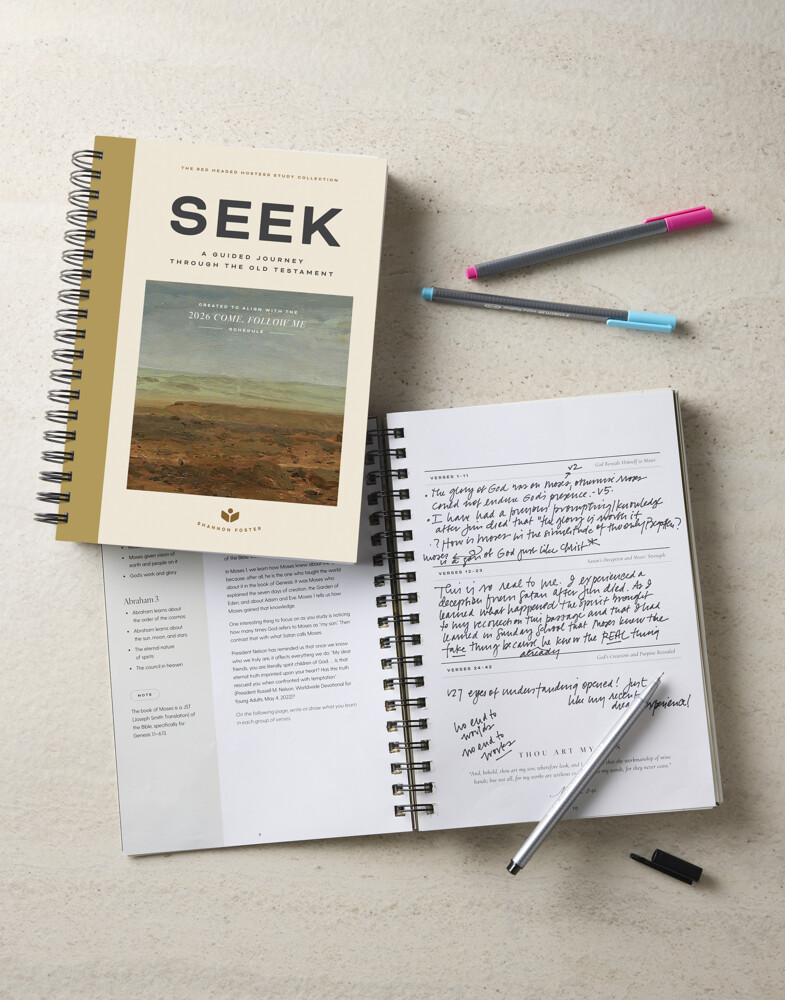
Deepen your study
- A stunning piece of commissioned or licensed artwork
- Insightful background on each section and key historical context
- Simple timelines and “people to know” for deeper understanding
- Guided questions and space to write, reflect, or draw
- Thoughtful prompts to help you slow down and record what the Spirit teaches you