
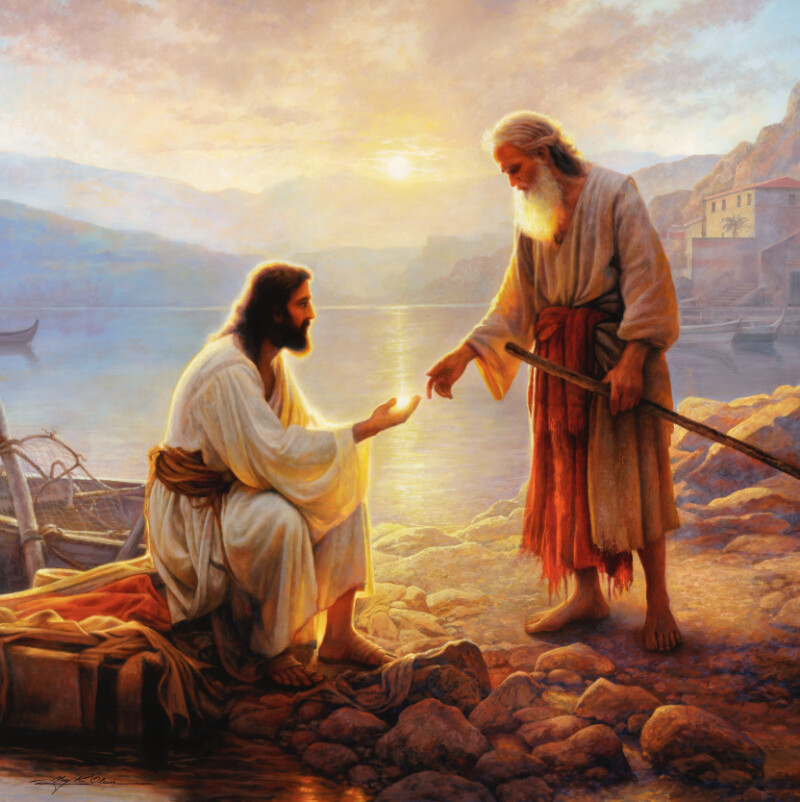
The key to the Father’s plan of salvation is the Atonement of Jesus Christ (see 3 Nephi 27:1–20). We need to understand the effects of the Atonement in our individual lives, we need to teach them to our members, and, so far as possible, we should teach them to men and women everywhere.
There are three essential powers of the Atonement of Jesus Christ: the assurance of immortality, the opportunity for eternal life, and the strength we can receive to sustain us through the many challenges of mortality. In each of these, His Only Begotten Son, Jesus Christ, is the central figure.
The Resurrection
President Thomas S. Monson explained this first essential power:
“No words in Christendom mean more to me than those spoken by the angel to the weeping Mary Magdalene and the other Mary when, on the first day of the week, they approached the tomb to care for the body of their Lord. Spoke the angel:
“‘Why seek ye the living among the dead?
“‘He is not here, but is risen’ (Luke 24:5–6).
“Our Savior lived again. The most glorious, comforting, and reassuring of all events of human history had taken place—the victory over death. The pain and agony of Gethsemane and Calvary had been wiped away. The salvation of mankind had been secured. The Fall of Adam had been reclaimed....
“My beloved brothers and sisters, in our hour of deepest sorrow, we can receive profound peace from the words of the angel that first Easter morning: ‘He is not here: for he is risen’ (Matthew 28:6).”¹
The book of Job poses the universal question, “If a man die, shall he live again?” (Job 14:14). The question of resurrection from the dead is a central subject of scripture, ancient and modern. The Resurrection is a pillar of our faith. It adds meaning to our doctrine, motivation to our behavior, and hope for our future.
The Resurrection of Jesus
The universal resurrection became a reality with the Resurrection of Jesus Christ (see Matthew 27:52–53). On the third day after His death and burial, Jesus came forth out of the tomb. He appeared to several men and women, and then to the assembled Apostles. Three of the Gospels describe this event. Luke is the most complete:
“Jesus ... saith unto them, Peace be unto you.
“But they were terrified and affrighted, and supposed that they had seen a spirit.
“And he said unto them, Why are ye troubled? and why do thoughts arise in your hearts?
“Behold my hands and my feet, that it is I myself: handle me, and see; for a spirit hath not flesh and bones, as ye see me have....
“Then opened he their understanding, ...
“And said unto them, Thus it is written, and thus it behoved Christ to suffer, and to rise from the dead the third day” (Luke 24:36–39, 45–46).
The Savior gave the Apostles a second witness. Thomas, one of the Twelve, had not been with them when Jesus came. He insisted that he would not believe unless he could see and feel for himself. John records:
“And after eight days again his disciples were within, and Thomas with them: then came Jesus, the doors being shut, and stood in the midst, and said, Peace be unto you.
“Then saith he to Thomas, Reach hither thy finger, and behold my hands; and reach hither thy hand, and thrust it into my side: and be not faithless, but believing.
“And Thomas answered and said unto him, My Lord and my God.
“Jesus saith unto him, Thomas, because thou hast seen me, thou hast believed: blessed are they that have not seen, and yet have believed” (John 20:26–29).
Despite these biblical witnesses, many who call themselves Christians reject or confess serious doubts about the reality of the Resurrection. As if to anticipate and counter such doubts, the Bible records many appearances of the risen Christ. In some of these He appeared to a single individual, such as to Mary Magdalene at the sepulchre. In others He appeared to large or small groups, such as when “he was seen of [more than] five hundred brethren at once” (1 Corinthians 15:6).
The Book of Mormon: Another Testament of Jesus Christ records the experience of hundreds who saw the risen Lord in person and touched Him, feeling the prints of the nails in His hands and feet and thrusting their hands into His side. The Savior invited a multitude to have this experience “one by one” (3 Nephi 11:15) so that they could know that He was “the God of Israel, and the God of the whole earth, and [had] been slain for the sins of the world” (3 Nephi 11:14).
During the course of His personal ministry among these faithful people, the resurrected Christ healed the sick and also “took their little children, one by one, and blessed them” (3 Nephi 17:21). This tender episode was witnessed by about 2,500 men, women, and children (see 3 Nephi 17:25).
The Resurrection of Mortals
The possibility that a mortal who has died will be brought forth and live again in a resurrected body has awakened hope and stirred controversy through much of recorded history. Relying on clear scriptural teachings, Latter-day Saints join in affirming that Christ has “broken the bands of death” (Mosiah 16:7) and that “death is swallowed up in victory” (1 Corinthians 15:54; see also Mosiah 15:8; 16:7–8; Alma 22:14; Mormon 7:5). Because we believe the Bible and Book of Mormon descriptions of the literal Resurrection of Jesus Christ, we also readily accept the numerous scriptural teachings that a similar resurrection will come to all mortals who have ever lived upon this earth (see 1 Corinthians 15:22; 2 Nephi 9:22; Helaman 14:17; Mormon 9:13; Doctrine and Covenants 29:26; 76:39, 42–44). As Jesus taught, “Because I live, ye shall live also” (John 14:19). And His Apostle taught that “the dead shall be raised incorruptible” and “this mortal shall have put on immortality” (1 Corinthians 15:52, 54).
The literal and universal nature of the Resurrection is vividly described in the Book of Mormon. The prophet Amulek taught:
“The death of Christ shall loose the bands of this temporal death, that all shall be raised from this temporal death.
“The spirit and the body shall be reunited again in its perfect form; both limb and joint shall be restored to its proper frame, even as we now are at this time; ...
“Now, this restoration shall come to all, both old and young, both bond and free, both male and female, both the wicked and the righteous; and even there shall not so much as a hair of their heads be lost; but every thing shall be restored to its perfect frame” (Alma 11:42–44).
Alma also taught that in the Resurrection “all things shall be restored to their proper and perfect frame” (Alma 40:23).
For God’s children, resurrection means that aging, deterioration, and decay will be done away. “This mortal shall put on immortality” (Mosiah 16:10), and “the spirit and the body shall be reunited again in its perfect form” (Alma 11:43).
Resurrection also makes possible another reuniting—the reuniting of families. We live together in love, so we weep when a loved one dies (see Doctrine and Covenants 42:45). But like Mary Magdalene, we can have our tears of sorrow turn into tears of joy as we anticipate the future from the perspective of an eternal family.
Many living witnesses can testify to the literal fulfillment of these scriptural assurances of the Resurrection. Many, including some in my own extended family, have seen a departed loved one in vision or personal appearance and have witnessed their restoration in “proper and perfect frame” in the prime of life. Whether these were manifestations of persons already resurrected or of righteous spirits awaiting an assured resurrection, the reality and nature of the resurrection of mortals is evident. What a comfort to know that all who have been disadvantaged in life from birth defects, from mortal injuries, from disease, or from the natural deterioration of old age will be resurrected in “proper and perfect frame.”

The Significance of the Resurrection
I wonder if we fully appreciate the enormous significance of our belief in a literal, universal resurrection. The assurance of immortality is fundamental to our faith. The Prophet Joseph Smith declared:
“The fundamental principles of our religion are the testimony of the Apostles and Prophets, concerning Jesus Christ, that He died, was buried, and rose again the third day, and ascended into heaven; and all other things which pertain to our religion are only appendages to it.”²
Of all things in that glorious ministry, why did the Prophet Joseph Smith use the testimony of the Savior’s death, burial, and Resurrection as the fundamental principle of our religion, saying that “all other things ... are only appendages to it”? The answer is found in the fact that the Savior’s Resurrection is central to what the prophets have called “the great and eternal plan of deliverance from death” (2 Nephi 11:5).
When we understand the vital position of the Resurrection in the “plan of redemption” that governs our eternal journey (Alma 12:25), we see why the Apostle Paul taught, “If there be no resurrection of the dead, then ... is our preaching vain, and your faith is also vain” (1 Corinthians 15:13–14). We also see why the Apostle Peter referred to the fact that God the Father, in His abundant mercy, “hath begotten us again unto a lively hope by the resurrection of Jesus Christ from the dead” (1 Peter 1:3; see also 1 Thessalonians 4:13–18).
The “lively hope” we are given by the Resurrection is our conviction that death is not the conclusion of our identity but merely a necessary step in the destined transition from mortality to immortality. This hope changes the whole perspective of mortal life. The assurance of resurrection and immortality affects how we look on the physical challenges of mortality, how we live our mortal lives, and how we relate to those around us.
The assurance of resurrection gives us the strength and perspective to endure the mortal challenges faced by each of us and by those we love, such things as the physical, mental, or emotional deficiencies we bring with us at birth or acquire during mortal life. Because of the Resurrection, we know that these mortal deficiencies are only temporary!
The assurance of resurrection also gives us a powerful incentive to keep the commandments of God during our mortal lives. Resurrection is much more than merely reuniting a spirit to a body held captive by the grave. We know from the Book of Mormon that the Resurrection is a restoration that brings back “carnal for carnal” and “good for that which is good” (Alma 41:13; see also Alma 41:2–4 and Helaman 14:31). The prophet Amulek taught, “That same spirit which doth possess your bodies at the time that ye go out of this life, that same spirit will have power to possess your body in that eternal world” (Alma 34:34). As a result, when persons leave this life and go on to the next, “they who are righteous shall be righteous still” (2 Nephi 9:16), and “whatever principle of intelligence we attain unto in this life ... will rise with us in the resurrection” (Doctrine and Covenants 130:18).
The principle of restoration also means that persons who are not righteous in mortal life will not rise up righteous in the Resurrection (see 2 Nephi 9:16; 1 Corinthians 15:35–44; Doctrine and Covenants 88:27–32). Moreover, unless our mortal sins have been cleansed and blotted out by repentance and forgiveness (see Alma 5:21; 2 Nephi 9:45–46; Doctrine and Covenants 58:42), we will be resurrected with a “bright recollection” (Alma 11:43) and a “perfect knowledge of all our guilt, and our uncleanness” (2 Nephi 9:14; see also Alma 5:18). The seriousness of that reality is emphasized by the many scriptures suggesting that the Resurrection is followed immediately by the Final Judgment (see 2 Nephi 9:15, 22; Mosiah 26:25; Alma 11:43–44; 42:23; Mormon 7:6; 9:13–14). Truly, “this life is the time for men to prepare to meet God” (Alma 34:32).
The assurance that the Resurrection will include an opportunity to be with our family members—husband, wife, parents, brothers and sisters, children, and grandchildren—is a powerful encouragement for us to fulfill our family responsibilities in mortality. It helps us live together in love in this life in anticipation of joyful reunions and associations in the next.
Our sure knowledge of a resurrection to immortality also gives us the courage to face our own death—even a death that we might call premature. Thus, the people of Ammon in the Book of Mormon “never did look upon death with any degree of terror, for their hope and views of Christ and the resurrection; therefore, death was swallowed up to them by the victory of Christ over it” (Alma 27:28).
The assurance of immortality also helps us bear the mortal separations involved in the death of our loved ones. Every one of us has wept at a death, grieved through a funeral, or stood in pain at a graveside. I am surely one who has. We should all praise God for the assured Resurrection that makes our mortal separations temporary and gives us the hope and strength to carry on.
The Resurrection and Temples
We are living in a glorious season of temple building. This is also a consequence of our faith in the Resurrection. I was once privileged to accompany President Gordon B. Hinckley to the dedication of a new temple. In that sacred setting I heard him say:
“Temples stand as a witness of our conviction of immortality. Our temples are concerned with life beyond the grave. For example, there is no need for marriage in the temple if we were only concerned with being married for the period of our mortal lives.”
This prophetic teaching enlarged my understanding. Our temples are living, working testimonies to our faith in the reality of the Resurrection. They provide the sacred settings where living proxies can perform all of the necessary ordinances of mortal life in behalf of those who live in the world of the spirits. None of this would be meaningful if we did not have the assurance of universal immortality and the opportunity for eternal life because of the Resurrection of our Lord and Savior, Jesus Christ.
Read more in Learning the Great Fundamentals by Dallin H. Oaks. Available at Deseret Book and deseretbook.com.
Build and strengthen your testimony
Notes
The content of this article was drawn from the following sources: Dallin H. Oaks, “Resurrection,” Ensign, May 2000; Dallin H. Oaks, “Strengthening Faith in Heavenly Father and in Jesus Christ and His Atonement,” General Authority training, September 30, 2015; Dallin H. Oaks, “What Has Our Savior Done for Us?,” Ensign or Liahona, May 2021.
1. Thomas S. Monson, “He Is Risen!” Ensign, May 2010.
2. Teachings of the Prophet Joseph Smith, sel. Joseph Fielding Smith (1976), 121.