
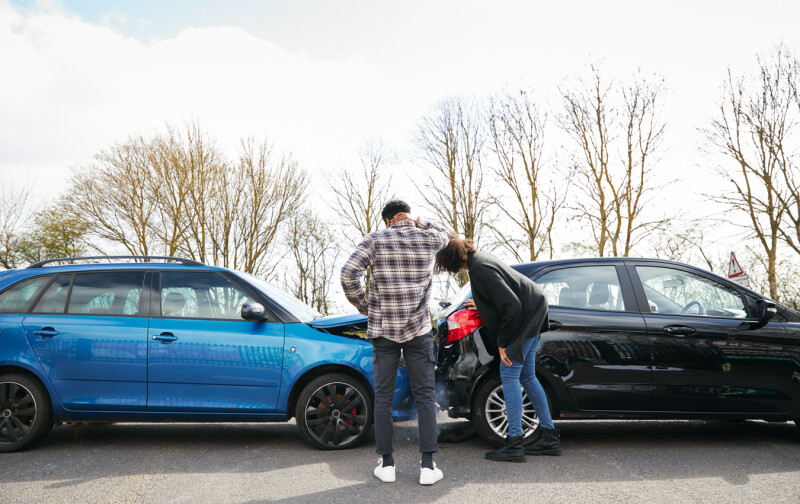
Try to imagine yourself driving down the freeway on a beautiful fall day. The leaves on the trees are stunning, absolutely gorgeous; the colors are many and varied. As you continue to look to your left and then look to your right to take it all in, you suddenly realize, to your horror, that you haven’t been paying enough attention to what is directly in front of you—namely an automobile! Before you know it, you bump into the back of the car and suddenly feel sick all over. The man in that car pulls off the road and you do the same. You come to a stop, loosen your seat belt, and throw open your door.
You slide out from behind the wheel, close your door, and hear the driver of the car in front of you call out, “Are you okay? Are you hurt in any way?” You quickly respond that you are fine and make your way to the front of your vehicle. You notice a few scratches here and there but are astonished that more damage hasn’t been done. The man quickly walks up to you and asks, “Did we do much damage to your car?” He looks carefully and says, “Wow, your car came through without any damage at all.” You then walk to his vehicle, glance at the bumper, and realize that much of the rear of his car has been bashed in. He says, “Well, my car didn’t do so well, did it?” You immediately begin to apologize and suggest that you both get your insurance information. He then surprises you with, “No, that isn’t necessary; we don’t need to do that.” You respond quickly: “Well, we’d better exchange information and make contact with the highway patrol.”
You are shocked by his reply: “That really isn’t necessary. Let me explain something to you. I’m a very wealthy man. I happen to own seven automobiles, and I absolutely hate this car! I have wanted to sell it for a long time, and so this accident will do just what I had hoped to be able to do—get rid of it! I will make a call and have the car towed away.” You try a few more times to convince him otherwise, but he absolutely refuses to do anything except get the car towed away. He then says to you: “I don’t want you to worry about this anymore. You take off and go about your business. There’s no reason to let this ruin your day!” To be sure, it is an odd situation, but after a brief conversation, you realize that the man is thoroughly genuine and is simply trying to prevent you from having a bad day.
What just happened here? That kind gentleman just kept you from getting a ticket, from having insurance premiums go up, and in general from having a thoroughly rotten day. To put this another way, what he has just done is to show mercy to you. In a colloquial and rather simple way, mercy is not getting what you deserve. On the other hand, grace is getting what you don’t deserve!
I remember very well sitting with a BYU colleague many years ago. We were talking about the plan of salvation, about rewards and punishment at the time of judgment. Without thinking much about it, I sounded off: “Well, I just want to get what I deserve.” My friend gazed into my eyes with a rather stern look and said, “Bob Millet, you’d better pray to God that you don’t get what you deserve!” Well, of course he was right. In a way, God the Father’s plan of salvation makes it possible, through the atoning work of His Beloved Son, that I don’t need to “get what I deserve.”
In our daily conversations, the words mercy and grace are occasionally used interchangeably, but in a real sense they are not identical. The following are some of the less well-known definitions given for mercy: “temporary immunity; the act of withholding deserved punishment; God not giving us punishment we deserve.”
A person cannot earn the grace of God; one earns a paycheck. Grace is God’s unearned divine assistance, unmerited divine favor, the Father and the Son’s enabling power, a divine strength and an empowered will to do that which we could never do for ourselves.
...
To put it simply, the Lord’s Atonement does more than fix the celestial books and balance the scales of justice and mercy. It even does more than forgive our sins. It rehabilitates, regenerates, renews, and transforms human nature. Christ makes us better, worlds better, than we would have been had there been no Fall. Redeemed humanity will rise far higher hereafter than any unfallen humanity might have done.
Over the years I have appreciated these insightful words of Elder Bruce C. Hafen:
“I once wondered if those who refuse to repent but who then satisfy the law of justice by paying for their own sins are then worthy to enter the celestial kingdom. The answer is no. The entrance requirements for celestial life are simply higher than merely satisfying the law of justice. For that reason, paying for our sins will not bear the same fruit as repenting of our sins. Justice is a law of balance and order and it must be satisfied, either through our payment or his. But if we decline the Savior’s invitation to let him carry our sins, and then satisfy justice by ourselves, we will not yet have experienced the complete rehabilitation that can occur through a combination of divine assistance and genuine repentance. Working together, those forces have the power permanently to change our hearts and our lives, preparing us for celestial life.”1
Read more from Robert L. Millet in How Great Thou Art: Revealed Insights into God, Our Heavenly Father.

Gain a deeper understanding of God
Notes:
1. Bruce C. Hafen, The Broken Heart: Applying the Atonement to Life’s Experiences (Salt Lake City, UT: Deseret Book, 1989), 7–8; see also 148–50.
More articles for you:
▶ 5 ways your words can bless the people in your home
▶ This hauntingly beautiful hymn might become a new Church favorite
▶ The power of a short lesson: Making 25 minutes count